
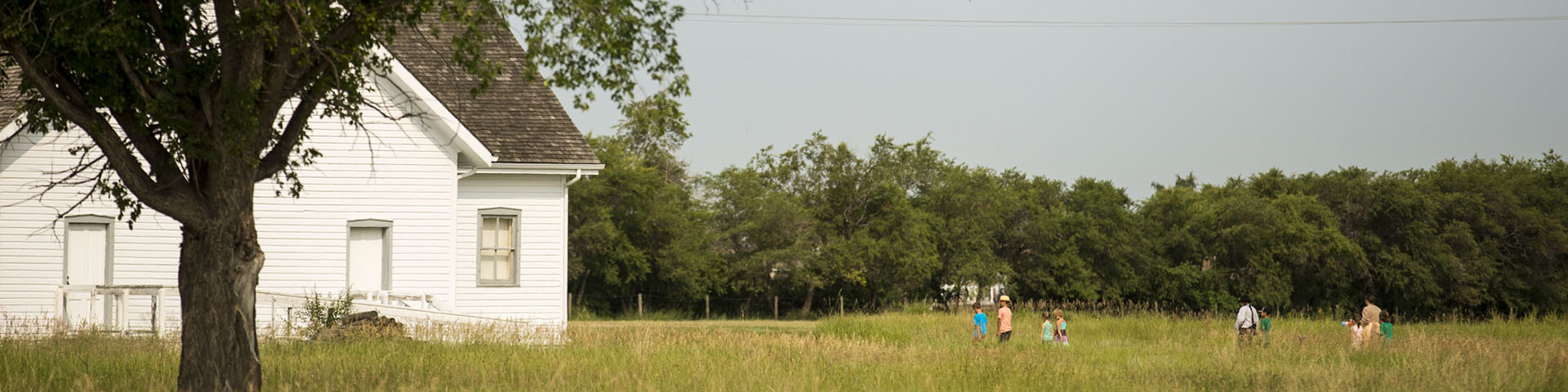
Self-Guided Tour
Fort Battleford National Historic Site
Pick up a map of the site and make your way around at your own pace. Look for opportunities to connect with interpreters and share your thoughts on the compelling history here.
A. Visitor Centre
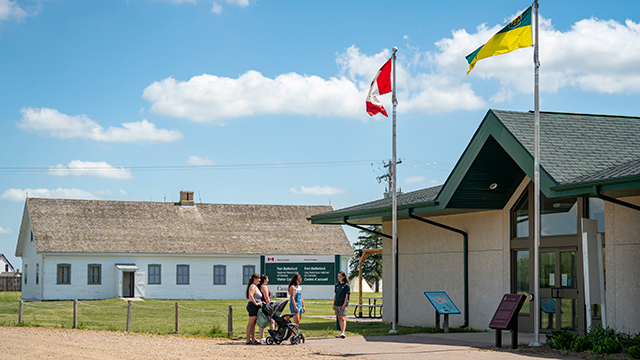
The visitor centre hosts an information and reception area, restroom facilities, displays, indoor seating area, outdoor patio, and gift shop.
B. Interpretation and picnic area
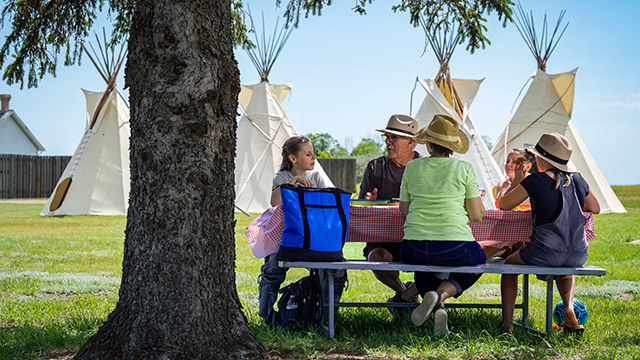
Enjoy the shaded picnic area or sit inside one of the nearby tipis. Check Tours and Programs for guided experiences.
1. Barracks #5
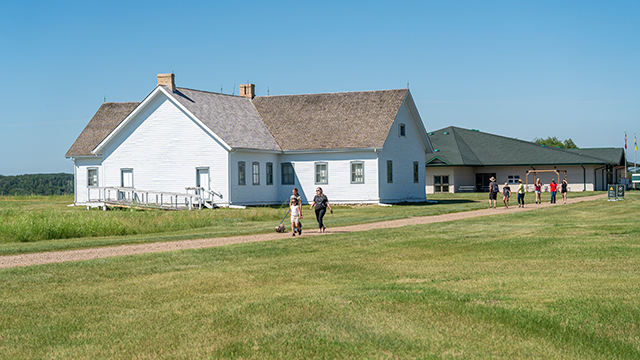
The town of Battleford was the first capital of the North-West Territories, a huge jurisdictional expanse that was created after Canada purchased Rupert’s Land from the Hudson’s Bay Company. Indigenous people were not involved in this purchase or transfer. After the 1885 North-West Resistance, the North-West Mounted Police garrison at Fort Battleford was increased. The additional men needed a place to live, and Barracks #5 was built in 1886 along with several other buildings in the area outside the palisade.
2. Learn and reflect
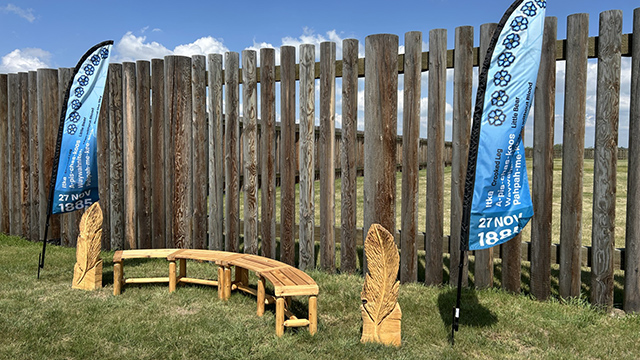
After the 1885 North-West Resistance, several First Nations men were imprisoned at Fort Battleford, including those implicated in the violence at Frog Lake. Trials were hastily held in Battleford without adequate interpretation or legal representation. Eleven First Nations men were sentenced to death, three who later had their sentences commuted to life imprisonment. Eight nêhiyawak and Nakoda men were executed here on November 27, 1885, in Canada’s largest mass hanging. Their names are: Kah-Paypamhchakwew (Wandering Spirit), Pahpah-me-kee-sick (Round the Sky), Manchoose (Bad Arrow), Kit-ahwah-ke-ni (Miserable Man), Nahpase (Iron Body), A-pis-cchas-koos (Little Bear), Itka (Crooked Leg), and Waywahnitch (Man Without Blood).
3. Flag exhibit
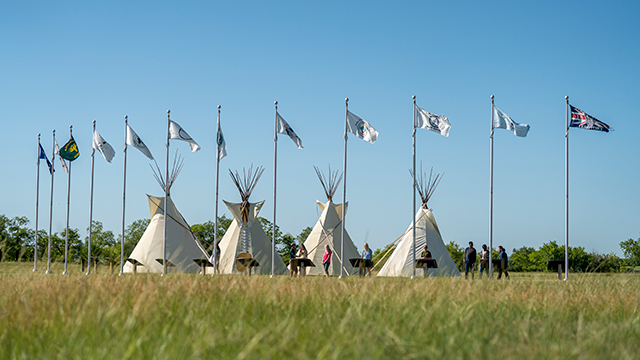
This land has been home to many peoples over the centuries, including the A’ananin, Nakawe, nêhiyawak, and Nakoda. The flags here represent the Indigenous nations currently in the region: Poundmaker, Lucky Man, Moosomin, Stoney Knoll, Sweetgrass, Little Pine, Red Pheasant, Saulteaux, Thunderchild, and Mosquito-Grizzly Bear’s Head-Lean Man, and Métis. The Treaty 6 flag also flies here. Treaty 6 was signed in 1876 and covers the area of Saskatoon, Prince Albert, the Battlefords, and Edmonton. First Nation leaders signed treaties to provide for future generations. The Crown wanted access to the land and resources of what is now western and northern Canada. By the late 1870s, bison were nearly eradicated causing widespread starvation. Smallpox and other disease epidemics also caused much devastation.
4. Guard House
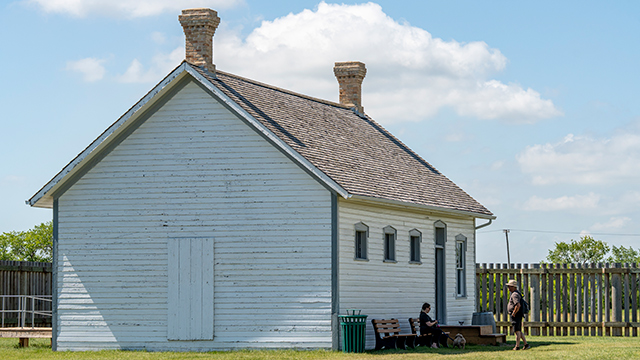
When the police post was built in 1876, it was known as Battleford Post and had a garrison of only fourteen men. The original post was not defensive, and the rough palisade was added later in 1879 to keep wildlife out of the gardens. By 1884, twelve buildings stood within the palisade. The original palisade was reinforced during the 1885 North-West Resistance when over 500 settlers crowded into the fort.
The Guard House was built in 1879 near the entrance of what is now the Kramer Campground. In the 1890s, it was moved closer to Barracks #5 and a new cement floor was added. The cement was three times thicker under the prisoner cell block than it was under the guard room. In the 1940s, it was moved to its present location. The yellow bricks in the chimney were made from local Battleford earth.
5. Sick Horse Stables
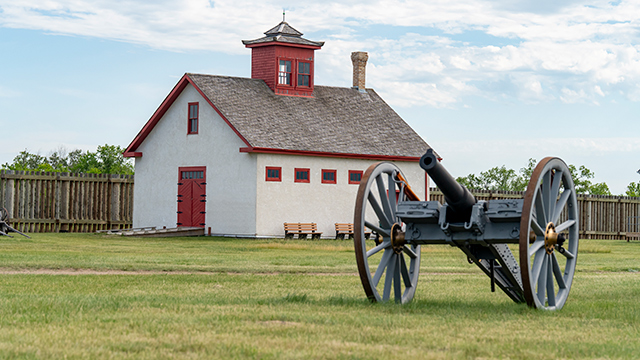
Originally, Fort Battleford was planned to include a large U-shaped stable for 160 horses, but it was never built. Instead, three long dirt-floor stables were built side by side, each capable of housing thirty-two horses. Additional stables were built from 1886 onward outside the palisade. The only remaining stable is the Sick Horse Stable. Built in 1898, it was first outside the palisade and moved inside in the 1940s. The ramp on one end of the building was designed to more easily move sick or injured horses in and out. The “lantern” on top of the gable roof is its most striking feature, allowing ventilation and light into the stable.
6. Officer’s Quarters
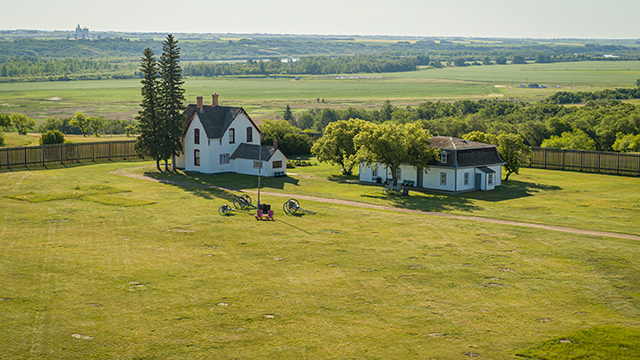
The Officers’ Quarters was built between 1884 and 1886. Originally it housed unmarried officers, with their offices upstairs. In 1894, it was renovated to accommodate officers’ families and included the addition of a billiards room. The summer kitchen and verandah were added later. Built in the Red River frame construction style, the building reflects the prevailing Eastern Canadian architectural influences of the period, featuring a mansard roof and decorative exterior detailing.
7. Commanding Officer’s Residence
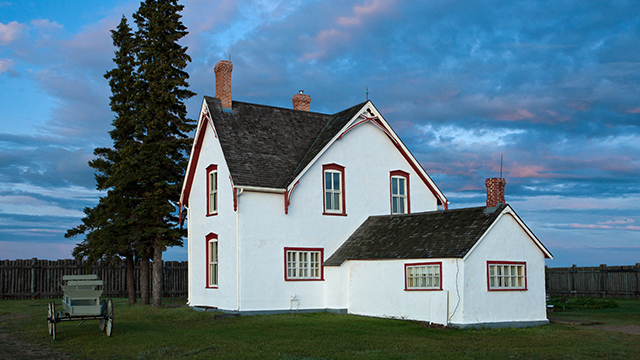
The Commanding Officer’s Residence is the only structure from 1876 still standing. Along with Government House, it was designed by prominent architects from Ottawa’s Department of Public Works. Built in the Gothic Revival style, the Residence was adapted to the local setting using regional materials, such as logs covered in clapboards and stucco, and the addition of porches over the entrances to provide protection from extreme cold and reduce dust during summer heat. These features reflect the “Canadian vernacular” approach to construction. Behind the Residence were gardens, considered at the time as a mark of civilization.
8. River view
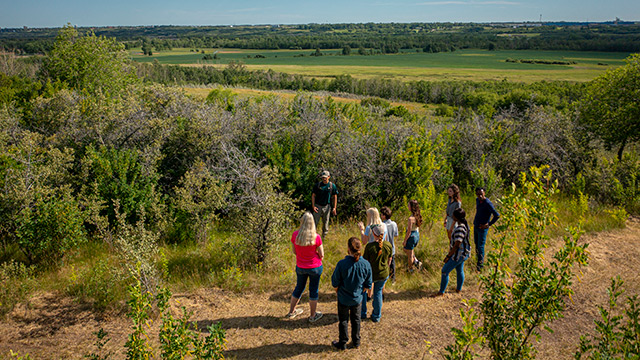
Fort Battleford stands on high ground between the North Saskatchewan and Battle Rivers, which converge nearby before flowing east and north into Lake Winnipeg. Its elevated position provided defense against attacks from all directions and kept it separate from the town and government buildings, while remaining close to local trails. Although water was readily available, hauling it up the steep riverbank was a challenge. The surrounding land was well-suited for haying, an important consideration when caring for numerous horses.
- Date modified :