
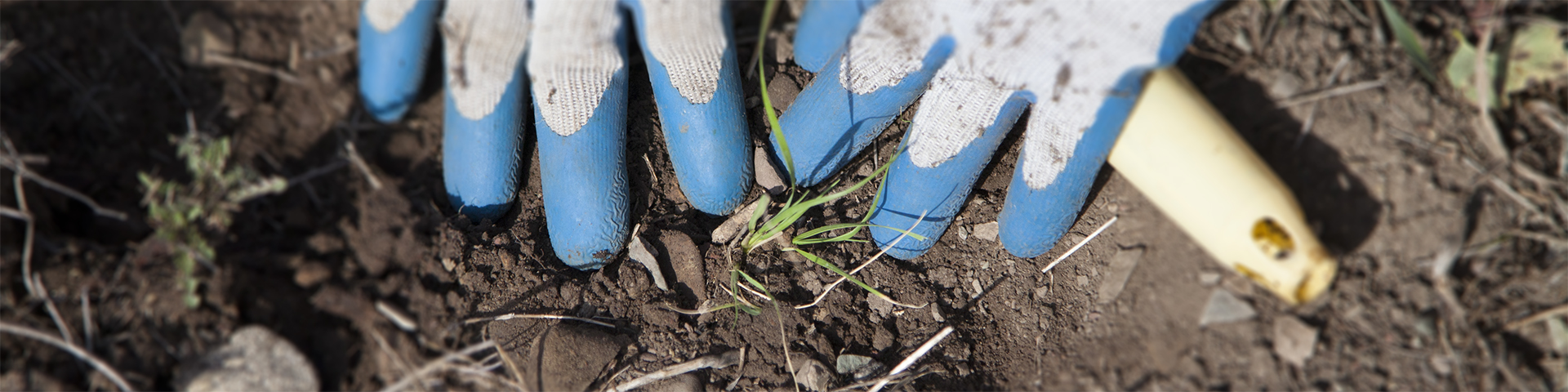
Native plant species and site restoration
Waterton Lakes National Park
Using native plants to restore disturbed sites is an essential component in the support of healthy ecosystems. They enhance wildlife habitat and reduce the potential spread of invasive, non-native plant species. We use several strategies to maintain healthy grassland ecosystems. Revegetation, prescribed fire, and non-native plant control are important strategies, often all used together.
Protecting foothills parkland
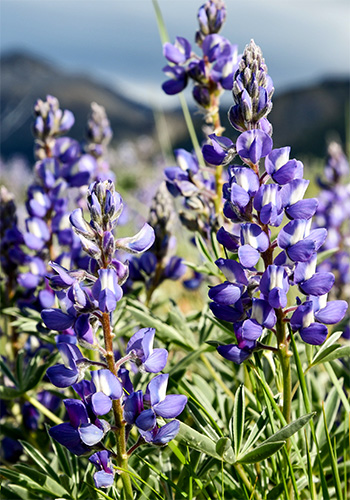
Waterton Lakes is the only national park in Canada actively protecting the foothills parkland ecoregion. Grassland ecosystems are among the most threatened in the world. Alberta's foothills fescue and foothills parkland grassland ecosystems have declined due to cultivation, development and invasive species. Only between 16 and 35 per cent of Alberta’s natural grasslands remain.
Planning and managing for disturbed sites
There are several projects underway in Waterton Lakes to revegetate disturbed locations with native plants. For construction projects, Parks Canada’s Impact Assessment and Resource Conservation teams work to minimize changes to the natural landscape. Much of the work takes place prior to construction, striving to disturb the area as little as possible. Sometimes, the impacts to the area are unavoidable. This is when Parks Canada plans for post-construction landscape restoration.
Restoration in Waterton Lakes
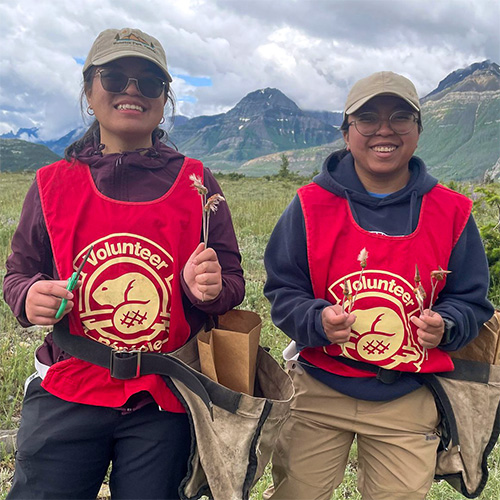
One of the first steps is collecting seeds from native plant species thanks to the work of Parks Canada staff and volunteers. The collected seeds are sown directly into the ground or grown for later planting. More than 25,000 native grass and flowering plant (forb) plugs from 40 species are planted at restoration sites around the park. Planting and seeding are only part of the restoration story. Biologists monitor restored sites to gauge the effectiveness of the selected techniques. Monitoring also alerts us to any issues that might affect a restoration project’s success, such as the arrival of an invasive species.
Working together
Parks Canada values collaborating with stakeholders both in and outside of the park boundaries. In the spirit of the Waterton-Glacier International Peace Park, we work alongside Glacier National Park in site restoration and landscaping initiatives.
Restoring ecosystems can be very complicated work. By sharing knowledge and learning from our neighbours, we achieve better results. Our collaborations improve the availability of locally adapted native seeds and support other grassland restoration projects.
Saving a species: Limber pine (Pinus flexilis)
COSEWIC designation: Endangered
Limber pine trees are in decline and at risk of extinction. One of the main threats is white pine blister rust (a non-native fungus).
Parks Canada is working hard to restore five needle pine populations in Alberta and British Columbia. Here in Waterton, we’re collaborating with the Whitebark Pine Ecosystem Foundation of Canada on management of a limber pine orchard in Waterton.
Technicians collect cone bearing branches (called scions) from mature trees in the park. We select trees showing resistance to the invasive fungus Cronartium ribicola, also known as white pine blister rust.
The collected scions are grafted onto other young limber pine trees, known as rootstock. The rootstock is a healthy, and relatively young limber pine tree with strong roots. This makes it easy to move and plant in the orchard.
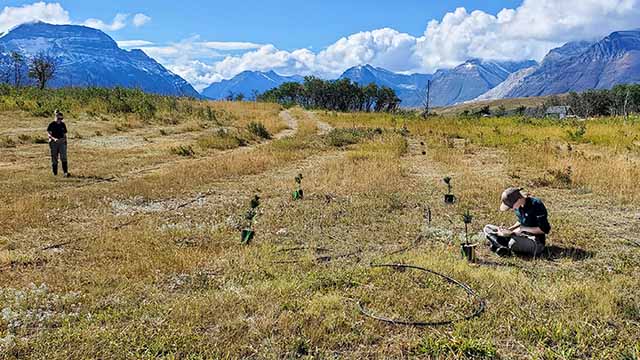
Established in 2020, the orchard is a specially designed place for these tiny species-savers to flourish. Growing in a controlled setting helps produce greater numbers of disease-resistant seeds. This process is similar to how farmers historically bred disease-resistant crops. The orchard is fenced, to limit interference by wildlife, giving these trees the best chance of survival. By the end of 2025, this site supported a population of 289 limber pines.
Learn more
Natural Resources Canada: White pine blister rust
COSEWIC assessment and status report: Limber pine
Connected: A Parks Canada podcast – Episode 5; Whitebark pine
Help save five-needle pine trees through volunteering
Related links
- Date modified :