
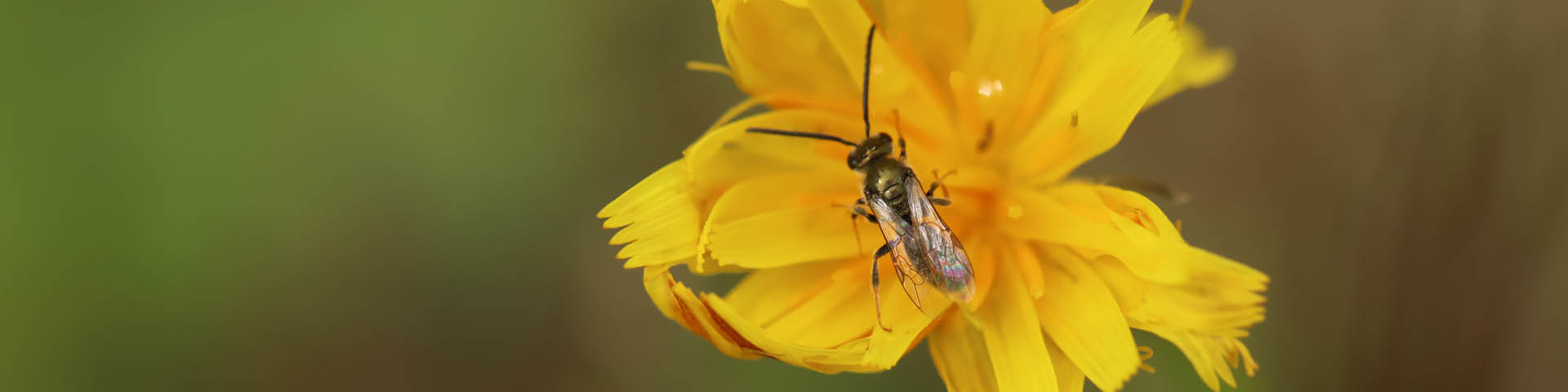
Sable Island Sweat Bee
Sable Island National Park Reserve
There are five species of bees found at Sable Island National Park Reserve, including two species of sweat bee: the Sable Island Sweat Bee and the Nova Scotia Sweat Bee. The Sable Island Sweat Bee (Lasioglossum sabelnse) is endemic to Sable Island, which means it is found nowhere else in the world.
On this page
Morphology
Sweat bees are a diverse group of small bees. There are almost 4500 species worldwide.
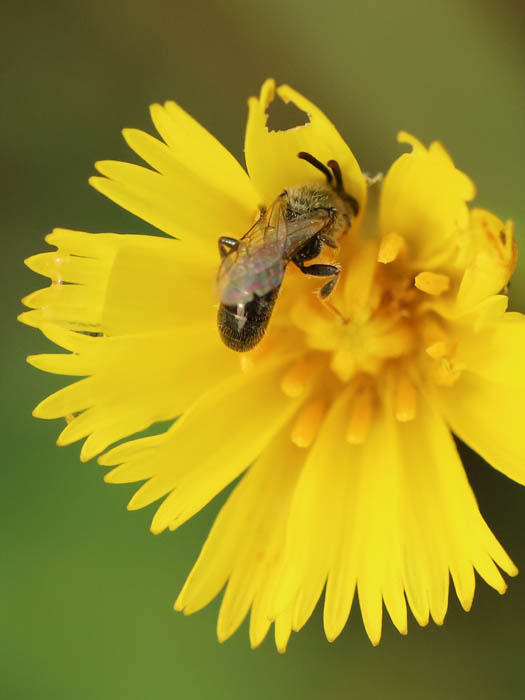
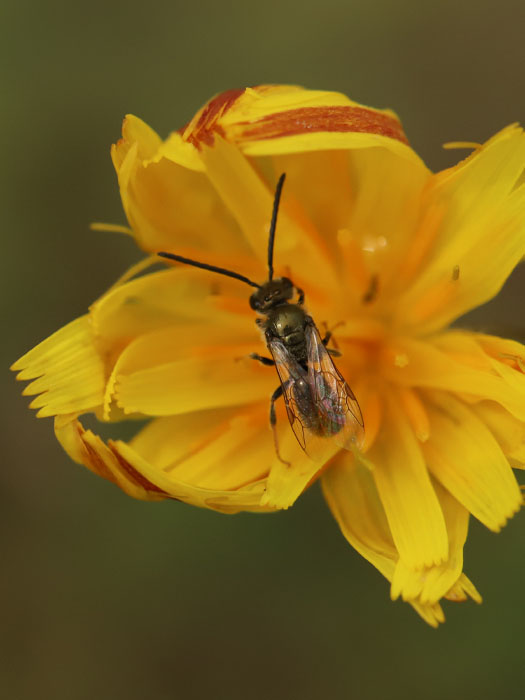
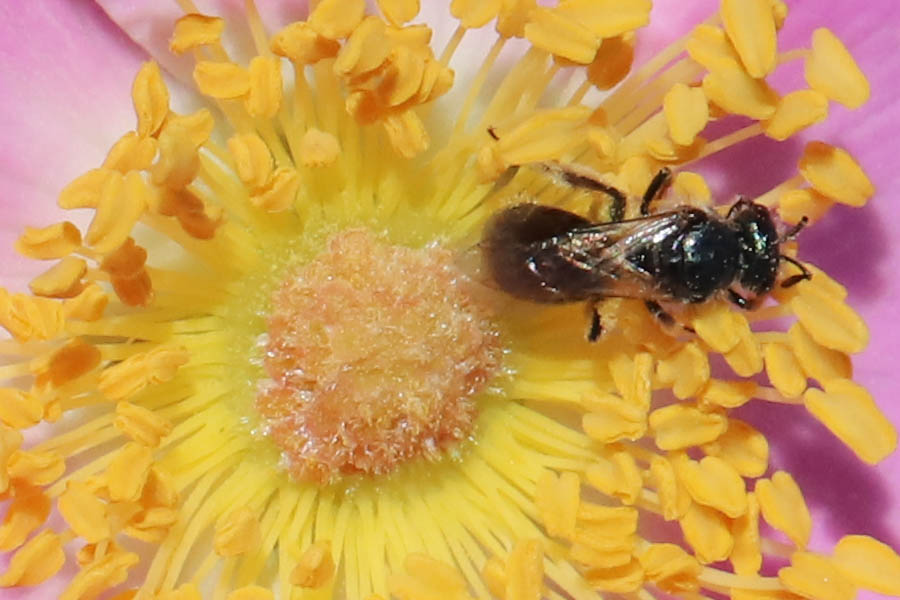
The Sable Island Sweat Bee is small in size (5-6 mm) and a dull-metallic colour.
Like for many insects, little is known about the basic biology and ecology of the Sable Island Sweat Bee.
Behaviour
Many species of sweat bee are attracted to sweat for the salt content, even on humans.
Sable Island Sweat Bees are active on Sable Island from mid-May to mid-October.
Habitat
Sweat bees are distributed across much of Sable Island. Their preferred foraging habitats are the heath and shrub communities.
Sweat bees play an important role as pollinators in the island’s ecosystems.
Sable Island Sweat Bees are generalist floral visitors or foraging generalists which means they forage on a variety of plants to collect pollen and nectar. They often forage on flowers within 1 km of their nesting sites.
Their forage flowers include:
- rose
- goldenrod
- clover
- dandelion
- yarrow
- pearly everlasting
Breeding and social structure
There are different breeding strategies for various sweat bee species.
Evidence suggests that Sable Island Sweat Bees are eusocial nesters. This is when there are only a few select females (queens) in a colony capable of breeding.
The non-reproductive bees are workers. The workers contribute to the success of the colony by collecting nectar and pollen, doing housekeeping, etc.
Nesting
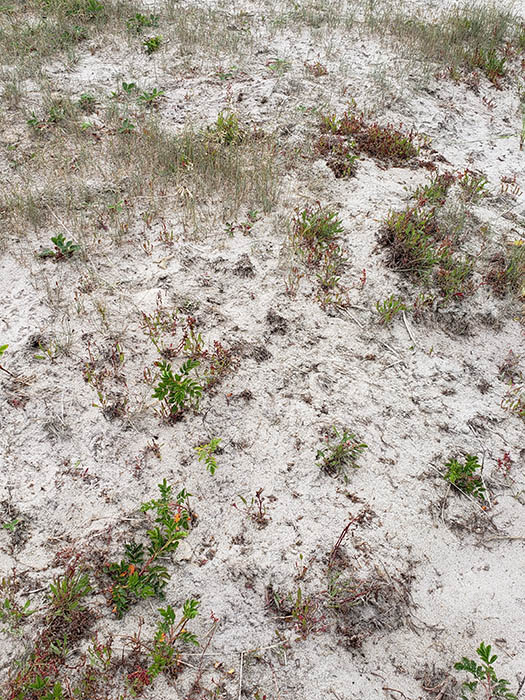
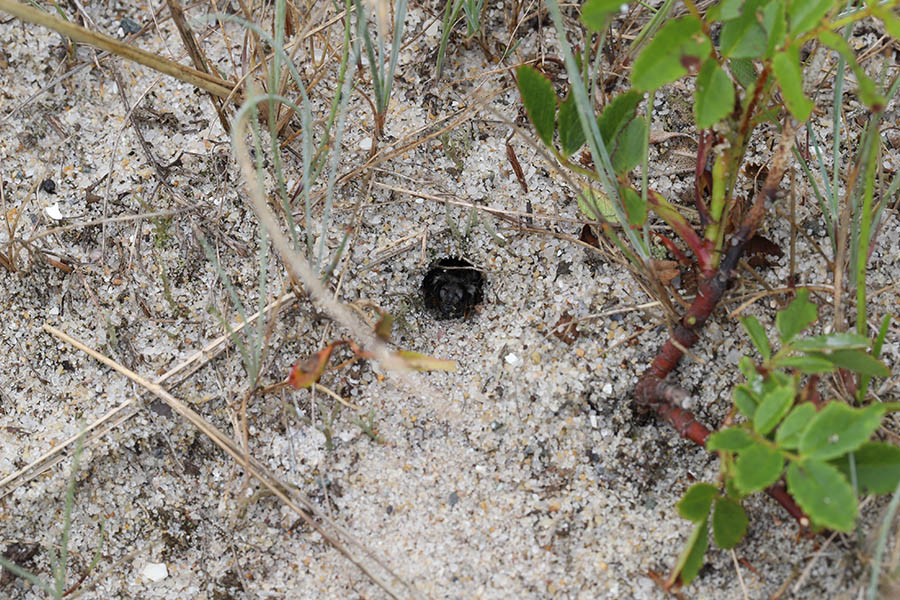
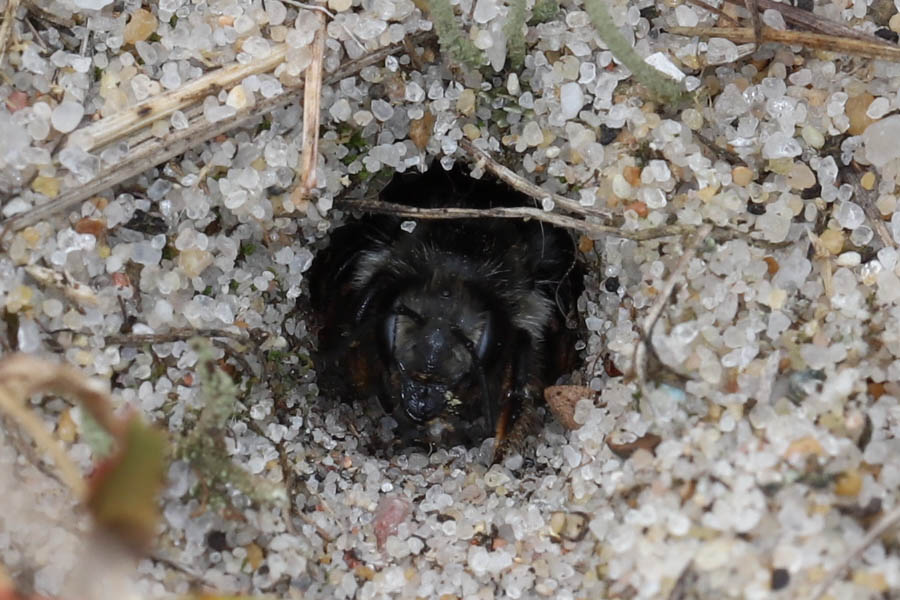
The Sable Island Sweat Bee is a ground-nesting species. Their nests are often found in the stable sparsely vegetated sand.
Research suggests that many species of sweat bee spend their winters underground and form new nests when they emerge in the spring.
Sable Island Sweat Bee
Transcript
There are no spoken words in this video.
Animated Parks Canada beaver logo.
The Sable Island Sweat Bee slowly emerges from a very small hole in the ground.
The Sable Island Sweat Bee flies away.
Parks Canada logo.
Canada wordmark.
Species at risk
The Sable Island Sweat Bee is listed as Threatened under the Species at Risk Act because of its restricted geographic location (Sable Island).
Threats
The 2014 Committee of the Status of Endangered Wildlife in Canada (COSEWIC) assessment identified a number of threats to the Sable Island Sweat Bee.
Threats include:
- rising sea levels
- potential changes in habitat on Sable Island
- non-native species
Protection and management
Parks Canada is committed to maintaining a stable population of the Sable Island Sweat Bee. Parks Canada published the Action Plan and Recovery Strategy for the Sable Island Sweat Bee (Lasioglossum sablense) in Canada in 2020. By implementing the recovery strategy for this species, Parks Canada is addressing key knowledge gaps and preventing or mitigating key threats.
Field inventories conducted in the past are important baselines of information for the recovery planning process and the monitoring, management, and protection of the Sable Island Sweat Bee.
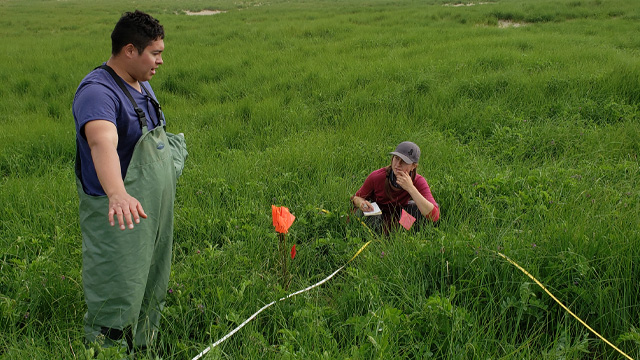
Collaborative stewardship with the Mi'kmaq Earth Keepers of Nova Scotia
Parks Canada and the Mi’kmaq Earth Keepers of Nova Scotia have been working together to learn about and monitor the Sable Island Sweat Bee at Sable Island National Park Reserve since 2021.
Learn more about collaborative stewardship
References
Sable Island Sweat Bee (Lasioglossum sablense): recovery strategy and action plan
Related links
- Date modified :